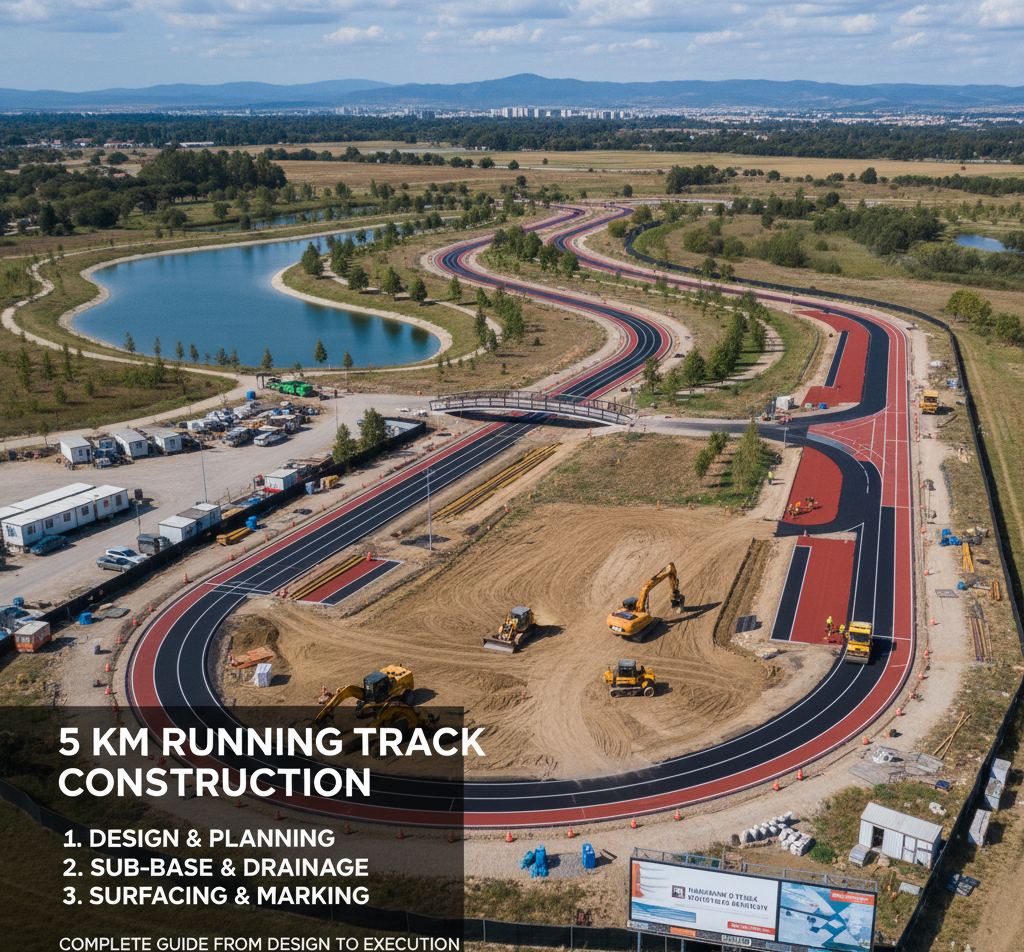
A 5-kilometer running track is one of the most effective fitness infrastructures for endurance training, recreational running, and community wellness. It offers the perfect balance—long enough to build stamina and cardiovascular strength, yet flexible enough to be integrated into parks, campuses, sports complexes, and urban green spaces.
However, constructing a 5 km running track involves far more than outlining a route. It requires engineering accuracy, surface performance planning, drainage design, user safety considerations, and environmental harmony.
This comprehensive guide explains the track process, from feasibility studies to surface selection, amenities, cost estimation, and long-term maintenance.
Step 1: Site Planning & Feasibility Assessment
Every successful running track begins with thorough planning. A 5 km track demands careful evaluation of land, purpose, and user needs.
Key Planning Considerations
-
Land Requirement: Typically 25–35 acres, depending on the layout and terrain
-
Intended Use: Public fitness, athletic training, or recreational walking
-
Topography: Flat or gently sloped land with natural water flow
-
Connectivity: Easy access, safe surroundings, and visual appeal
Modern 5 km tracks are often designed to wind through landscaped gardens, water bodies, forest belts, or open lawns, enhancing user experience and environmental integration.
Step 2: Track Layout & Geometric Design
Accurate layout planning ensures distance precision, runner comfort, and safety.
Common 5 KM Layout Options
-
Single Continuous Loop: One uninterrupted 5 km circuit (most preferred)
-
Segmented Loops: Multiple 1 km loops combined to reach 5 km
-
Trail Network System: Interlinked paths totaling 5 km (ideal for eco-parks)
Recommended Track Width
-
Minimum: 2.5 m (low traffic)
-
Standard: 3.0 – 3.5 m (public parks)
-
High-use / shared track: 4.0 – 5.0 m
Design Best Practices
-
Avoid tight turns (minimum curve radius: 20 meters)
-
Maintain gentle gradients (below 2%)
-
Provide rest or hydration points every 500–1000 meters
Step 3: Earthwork & Subgrade Preparation
A strong foundation ensures durability and prevents future surface failure.
Construction Process
-
Clearing vegetation and debris
-
Excavation and grading for level formation
-
Mechanical compaction of soil
-
Subgrade thickness: 150–200 mm
-
Cross slope of 1–2% for water runoff
Properly compacted subgrade minimizes cracking, settlement, and surface deformation.
Step 4: Base Layer Construction
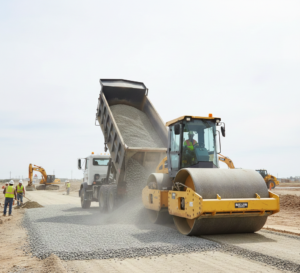
The base layer provides load-bearing capacity and structural integrity.
Typical Base Structure
-
Granular Sub-Base (GSB): 100–150 mm
-
Wet Mix Macadam (WMM): 75–100 mm
Each layer is compacted using rollers to achieve uniform density.
Total base thickness usually ranges between 200–300 mm, depending on soil conditions and usage load.
Step 5: Running Track Surface Selection
Surface choice directly impacts runner comfort, safety, lifespan, and maintenance.
Popular Surface Options
1. Asphalt (Bituminous) Track
-
Smooth and flexible running surface
-
Lifespan: 7–10 years
-
Moderate cost
-
Ideal for parks and campuses
2. Synthetic Rubber Track (EPDM / PU)
-
Superior shock absorption and joint protection
-
High traction and weather resistance
-
Lifespan: 8–12 years
-
Ideal for schools, fitness parks, and professional use
3. Concrete Track
-
Extremely durable (15+ years)
-
Low maintenance
-
Hard surface; less comfortable for long-distance running
4. Interlocking Paver Track
-
Decorative and repair-friendly
-
Good drainage
-
Suitable for residential parks
5. Natural Gravel or Soil Track
-
Eco-friendly and breathable
-
Requires frequent maintenance
-
Best for nature parks and rural zones
Recommended surface thickness: 25–50 mm depending on material.
Step 6: Drainage & Water Control System
Efficient drainage is critical for outdoor track longevity.
Drainage Features
-
Side drains along track edges
-
Cross slope for surface runoff
-
Permeable sub-layers
-
Optional rainwater harvesting pits
Without proper drainage, tracks can suffer from erosion, cracking, algae growth, and safety hazards.
Step 7: Lighting, Markings & User Amenities
A well-designed track enhances safety, usability, and motivation.
Essential Add-Ons
-
LED lighting poles every 20–25 meters
-
Distance markers at 100 m or 500 m intervals
-
Directional arrows and safety signage
-
Seating benches and shaded shelters
-
Drinking water points
-
Tree buffers and landscaped zones
Many modern tracks also integrate open gyms, stretching areas, and fitness stations.
Step 8: Finishing, Curing & Quality Testing
Once the surface is laid:
-
Rolling and leveling are completed
-
Curing period begins (7–10 days for most surfaces)
-
Markings are painted
-
Drainage and slope performance are tested
Only after inspection approval is the track opened for public use.
Step 9: Maintenance & Service Life
Routine maintenance preserves safety and performance.
Maintenance Activities
-
Daily sweeping and debris removal
-
Crack and joint inspections
-
Repainting markings every 1–2 years
-
Replacement of damaged surface sections
-
Drain and lighting system upkeep
With proper care, a 5 km track can remain functional for 10–15 years or more.
Indicative Construction Cost (India)
| Surface Type | Cost per Running Meter | Approx. Cost for 5 KM |
|---|---|---|
| Natural Gravel | ₹1,000 – ₹1,500 | ₹50 – ₹75 lakh |
| Asphalt | ₹2,000 – ₹3,000 | ₹1.0 – ₹1.5 crore |
| Paver Block | ₹2,500 – ₹3,500 | ₹1.25 – ₹1.75 crore |
| EPDM / Synthetic | ₹4,000 – ₹6,000 | ₹2.0 – ₹3.0 crore |
Costs vary based on soil condition, location, and infrastructure scope.
Environmental & Community Impact
A 5 km running track delivers long-term social and ecological benefits:
-
Encourages healthy lifestyles across age groups
-
Enhances green space utilization
-
Supports eco-friendly recreation
-
Strengthens community engagement through events and group runs
Many cities now incorporate 5 km tracks into urban sustainability and smart city projects.
Final Conclusion
A 5 km running track is not just a pathway—it is a lasting fitness asset. When planned with precision, built using quality materials, and supported by proper maintenance, it becomes a centerpiece of wellness, sustainability, and community life.
Key Takeaways
-
Ideal width: 3.0 – 3.5 meters
-
Best surfaces: Asphalt or EPDM
-
Land requirement: 25–35 acres
-
Maintenance: Regular cleaning and periodic resurfacing
A thoughtfully constructed 5 km track doesn’t simply support exercise—it creates a culture of health, connection, and active living.
FAQ – 5 KM Running Track Construction: Complete Guide from Design to Execution
1. What is a 5 KM running track?
A 5 KM running track is a dedicated pathway designed for running, jogging, and walking, with a total distance of 5 kilometers per lap or circuit. It is ideal for parks, schools, residential communities, and fitness zones.
2. What are the standard design features of a 5 KM running track?
- Track Length: 5,000 meters (5 KM)
- Track Width: 1.2–2 meters for single-lane; 3–4 meters for multi-lane tracks
- Surface Type: Asphalt, concrete, PU, or rubberized synthetic surfaces
- Curves & Turns: Gentle curves for safety and ergonomic running
- Markers: Distance markers every 500 meters or 1 km
3. What materials are used for 5 KM running track construction?
- Asphalt or Concrete Base: Ensures a stable and durable foundation
- PU (Polyurethane) Coating: Shock-absorbing, joint-friendly, weather-resistant
- EPDM Rubber Surface: Soft, non-slip, and ideal for outdoor fitness tracks
- Gravel or Compacted Soil: Used in cost-effective or natural tracks
4. How long does it take to construct a 5 KM running track?
Construction time depends on terrain, surface type, and site size:
- Basic outdoor track: 3–4 weeks
- PU or EPDM synthetic track: 4–6 weeks
- Professional sports-standard track: 6–8 weeks
5. How much does a 5 KM running track cost?
Cost varies depending on materials and amenities:
- Basic gravel or asphalt track: ₹20–40 lakh
- PU/EPDM synthetic track: ₹50–80 lakh
- High-end professional track with lighting and landscaping: ₹1 crore+
6. Can a 5 KM running track be built outdoors?
Yes. Outdoor tracks are popular in parks, residential complexes, and school campuses. Proper drainage, UV-resistant surfaces, and non-slip coatings ensure durability in all weather conditions.
7. How to maintain a 5 KM running track?
- Regular cleaning of debris, leaves, and dirt
- Inspect for cracks, potholes, or surface wear
- Repaint lane markings and distance markers
- Check drainage and prevent waterlogging
- Periodic resurfacing for synthetic tracks