Badminton is a fast-paced and exciting sport that demands precision, agility, and the right environment for peak performance. While most people focus on flooring materials or lighting, the court layout itself plays an equally crucial role in shaping how the game is played.
Whether you’re planning to build a professional badminton facility, a school sports hall, or a recreational setup, understanding the different types of badminton court layouts is essential.
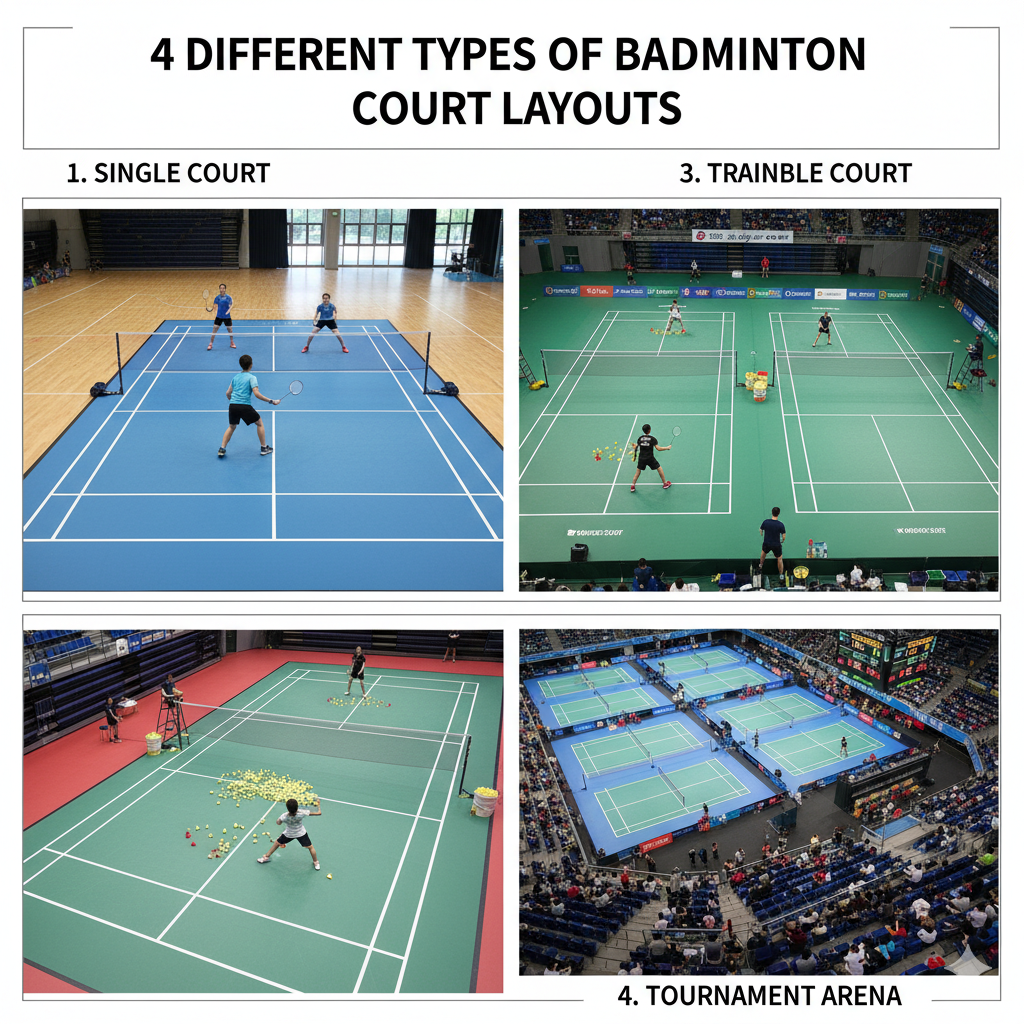
In this guide, we’ll explore the four main types of badminton court layouts, their dimensions, features, and ideal applications—so you can choose the best one for your project in 2025.
1. Standard Indoor Badminton Court Layout
Overview
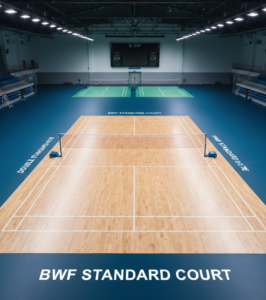
The indoor badminton court layout is the most widely used and officially recognized by the Badminton World Federation (BWF). It’s the layout used in professional tournaments, training academies, and sports complexes across the world.
Dimensions
According to BWF standards:
-
Total court length: 13.4 meters (44 feet)
-
Width for doubles: 6.1 meters (20 feet)
-
Width for singles: 5.18 meters (17 feet)
-
Net height: 1.55 meters (5 feet 1 inch) at the posts, and 1.524 meters (5 feet) at the center.
Key Zones
The standard layout includes:
-
Two service courts on each side – left and right.
-
Short service line: 1.98 meters from the net.
-
Long service line for doubles: 0.76 meters from the back boundary.
-
Long service line for singles: coincides with the back boundary.
Best Flooring Options
-
Maple or teak wooden flooring for professional play.
-
PVC or vinyl synthetic flooring for multi-purpose indoor halls.
Ideal For
-
Professional badminton academies
-
Indoor stadiums
-
School and college indoor sports halls
Advantages
-
Meets BWF tournament standards.
-
Provides consistent bounce and excellent player safety.
-
Ideal for year-round play regardless of weather.
Limitations
-
Requires dedicated indoor space and controlled climate conditions.
-
Higher installation and maintenance costs compared to outdoor layouts.
2. Outdoor Badminton Court Layout
Overview
Outdoor badminton courts are increasingly popular, especially in residential societies, schools, parks, and recreational clubs. They are designed to withstand environmental elements such as rain, sunlight, and temperature changes.
Dimensions
The outdoor court follows the same BWF measurements as the indoor layout:
-
Length: 13.4 meters (44 feet)
-
Width (doubles): 6.1 meters (20 feet)
-
Net height: 1.55 meters at the posts, 1.524 meters at the center.
However, the surrounding clearance area is often expanded for safety—allowing at least 2 meters of space beyond each boundary line.
Surface Materials
Outdoor courts typically use:
-
Acrylic flooring systems: Durable, weatherproof, and UV-resistant.
-
Modular polypropylene (PP) tiles: Interlocking design with drainage systems for fast drying.
-
Concrete base: As a stable foundation for either surface.
Lighting and Drainage
Modern outdoor badminton courts are equipped with:
-
LED floodlights (minimum 200–300 lux for recreational play).
-
Proper drainage systems to prevent water stagnation after rainfall.
Ideal For
-
Residential complexes
-
Parks and open community centers
-
Clubs and schools without large indoor space
Advantages
-
Cost-effective and easy to install.
-
Low maintenance and weather-resistant.
-
Great for casual or recreational play.
Limitations
-
Outdoor weather may affect performance and consistency.
-
Less cushioning compared to professional indoor courts.
3. Multipurpose Sports Hall Layout
Overview
A multi-sport layout is designed to accommodate multiple games—like badminton, volleyball, basketball, and indoor football—within one hall. The court lines for different sports are marked in varying colors to avoid confusion.
Dimensions
The badminton portion of the layout adheres to standard dimensions but fits into a shared floor plan that may include:
-
Two to four badminton courts arranged side by side.
-
A clear ceiling height of at least 9 meters, per BWF recommendations.
-
Sufficient run-off area between adjacent courts for player safety.
Flooring Materials
Because these spaces cater to different sports, the flooring must offer:
-
Shock absorption
-
Non-slip surface
-
Durability under heavy traffic
Common options include:
-
PU (Polyurethane) Sports Flooring – Seamless and multipurpose.
-
Vinyl Synthetic Flooring – Affordable, quick to install, and low-maintenance.
-
Engineered Wooden Flooring – For premium indoor sports complexes.
Ideal For
-
Schools and universities
-
Commercial sports clubs
-
Community recreation centers
Advantages
-
Maximizes space efficiency.
-
Ideal for multi-sport scheduling and training programs.
-
Easy maintenance and long lifespan.
Limitations
-
Line markings can be visually confusing.
-
Slightly reduced badminton-specific performance due to multi-use nature.
4. Portable or Temporary Badminton Court Layout
Overview
The portable badminton court layout is a modern innovation used for events, exhibitions, and temporary installations. These courts are designed for quick assembly, dismantling, and relocation—making them ideal for dynamic venues.
Dimensions
-
Follows the official BWF measurements for singles and doubles.
-
Usually includes modular flooring systems or roll-out mats pre-marked with lines.
Flooring Materials
Portable badminton courts are made using:
-
Interlocking PP tiles – Lightweight, durable, and easy to transport.
-
PVC roll mats – BWF-approved and can be laid over concrete or wooden subfloors.
-
PU portable surfaces – For professional tournaments and exhibitions.
Applications
-
National or international badminton events.
-
Sports expos, fairs, or corporate tournaments.
-
Temporary setups in auditoriums, halls, or open grounds.
Advantages
-
Fast installation and removal.
-
Cost-efficient for short-term or traveling events.
-
Flexible for use on different surfaces.
Limitations
-
Not ideal for permanent setups.
-
Slight compromise in grip or cushioning compared to permanent courts.
Bonus: Doubles vs. Singles Court Layout Differences
While all the above types follow BWF standards, remember that singles and doubles courts have different markings:
-
Singles court: Narrower playing area (5.18m width).
-
Doubles court: Wider (6.1m width) but shorter back service line.
This difference is marked by:
-
Side lines for singles (inner markings).
-
Side lines for doubles (outer markings).
When installing a court, make sure both sets of markings are visible if the court will host both match types.
Key Considerations for Choosing a Layout
When planning your badminton court, consider:
-
Purpose: Professional, recreational, or multi-purpose use.
-
Location: Indoor or outdoor.
-
Budget: Flooring material, lighting, and maintenance.
-
Climate: Humidity, temperature, and weather exposure.
-
Space Availability: Adequate clearance and safety zones.
A well-planned court layout enhances not only playability but also the longevity of the flooring system.
Conclusion
From traditional indoor setups to modular outdoor designs, badminton court layouts have evolved to fit every environment and purpose.
FAQ – 4 Different Types of Badminton Court Layouts: A Complete Guide for 2025
1. What are the standard dimensions of a badminton court?
A standard badminton court measures 13.4 meters (44 ft) long and 6.1 meters (20 ft) wide for doubles, while 5.18 meters (17 ft) wide for singles. The net height is 1.55 meters (5 ft 1 in) at the edges and 1.524 meters (5 ft) at the center.
2. What are the 4 different types of badminton court layouts?
The four common types of badminton court layouts include:
- Singles Court Layout – Narrower width, optimized for one-on-one matches.
- Doubles Court Layout – Full width for two-player teams.
- Half-Court Training Layout – Smaller section for practicing specific shots.
- Recreational/Compact Layout – Flexible design for multi-purpose spaces, often in schools or residential areas.
3. How does a singles badminton court layout differ from doubles?
- Singles: Width of 5.18 meters, full length 13.4 meters.
- Doubles: Width of 6.1 meters, same length, with additional side lines for doubles play.
The difference ensures fair play and proper spacing for singles vs. doubles matches.
4. What is a half-court badminton layout used for?
A half-court layout is used for:
- Skill drills and shot accuracy training
- Beginners and kids practice
- Fitness-focused badminton exercises
It reduces space requirements while maintaining effective gameplay.
5. What is a recreational or compact badminton court layout?
Recreational layouts are smaller, flexible courts designed for indoor gyms, apartments, and multipurpose halls. These layouts may not meet professional standards but allow casual play for fun and fitness.
6. What flooring types are best for badminton courts?
- Wooden Flooring (Maple or Oak) – Standard for professional indoor courts, smooth surface, shock absorption.
- PVC / Synthetic Flooring – Popular in schools and recreational halls, durable and easy to maintain.
- Outdoor Mats or Modular Tiles – Suitable for outdoor or multi-use spaces.
7. Can a badminton court be used for both singles and doubles?
Yes. A regulation-sized court accommodates both singles and doubles. Lines are clearly marked to differentiate singles and doubles boundaries for proper gameplay.